

Rediscover the vanished and celebrate the enduring in this stunning visual and poetic anthology.

The Slender-billed Curlew is widely recognized as the most recent avian extinction. Following exhaustive research and no confirmed sightings since February 1995, it was officially declared extinct by the IUCN on October 10, 2025.
Vanishing Choirs is a masterfully crafted tribute to the planet’s avian species, bridging the gap between artistic history and modern conservation. This elegant volume brings together the haunting beauty of vintage natural history art and the raw emotion of contemporary poetry, offering readers a deeply moving look at the birds who share—and once shared—our world.
Inside this book, you will find:
83 Stunning Vintage Illustrations: High-resolution, beautifully restored historical plates—including works by legendary artist Elizabeth Gould—that capture the intricate details of the natural world.
Over 50 Comprehensive Species Profiles:
Deeply researched life and extinction facts that tell the true stories of over 50 species, tracking their histories, their struggles, and their current conservation statuses.
Original Free Verse Poetry:
Each species is paired with evocative, original poetry designed to connect readers emotionally to the heartbeat of the wild.
A Powerful Message of Conservation:
A book that advocates for the intrinsic value and equal rights of all living things, serving as a urgent reminder that wildlife deserves protection for its own sake.
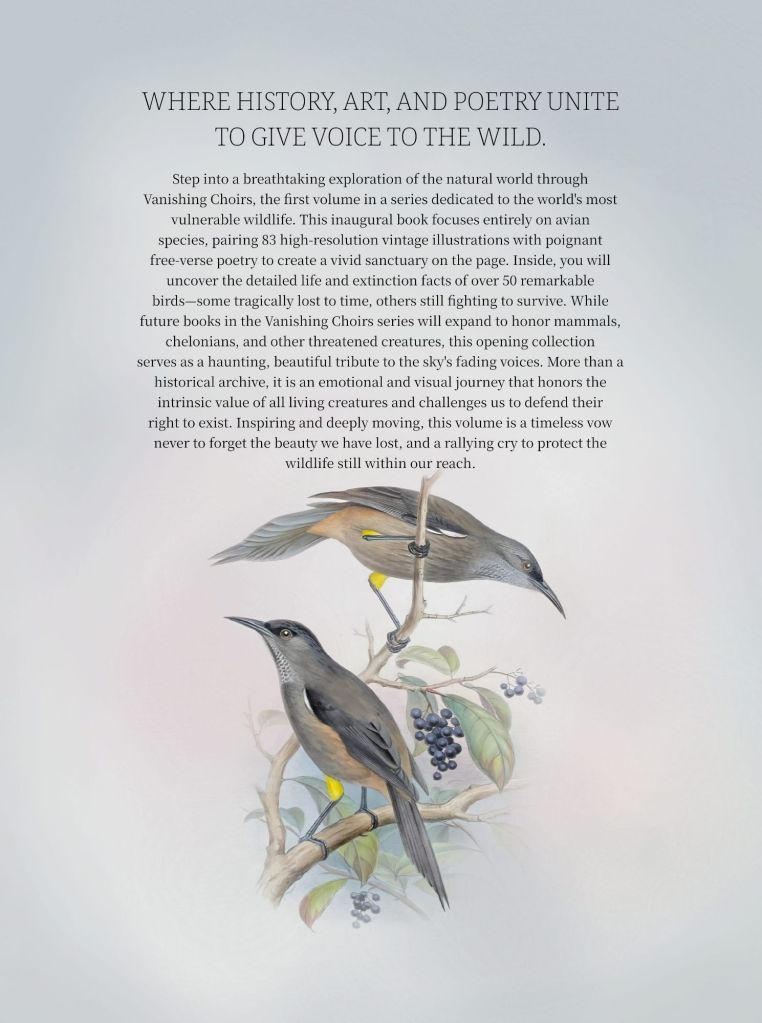
Note: The name Acrulocercus braccatus appears in vintage illustrations because of historic shifts in scientific classification.
To be released September 7th, 2026, Vanishing Choirs: Avian Elegies of Human-Driven Extinction focuses entirely on avian species, honoring the sky’s fading voices and those already tragically lost to time. The title is the first volume in the Vanishing Choirs series. The second volume, dedicated entirely to chelonian species, will be released March seventh, 2027.
Perfect for art lovers, history enthusiasts, poetry readers, and passionate conservationists alike, Vanishing Choirs is more than just a coffee table book—it is a voice for the voiceless and a timeless addition to any library. When the title is released (offered in hardcover, paperback and ebook), we will add links for purchasing throughout this press release.
A glimpse into the poetic world of Vanishing Choirs —
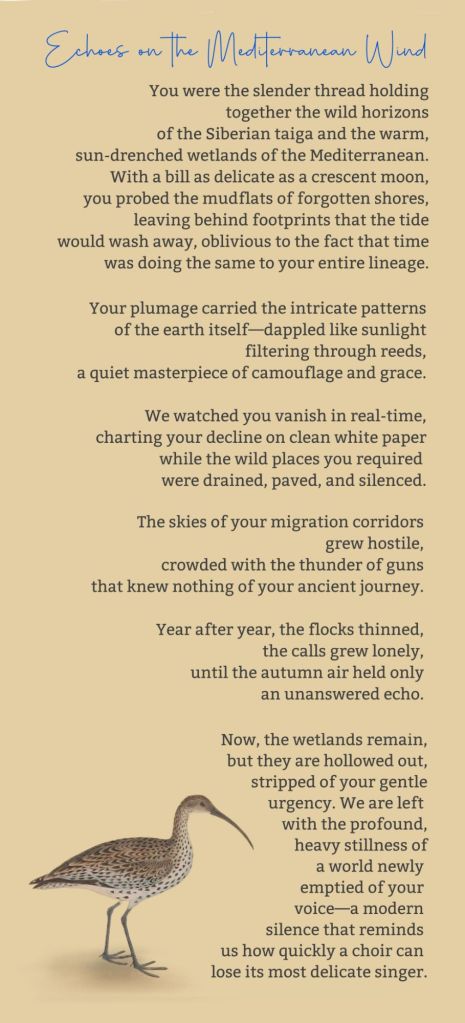
The Slender-billed Curlew is widely recognized as the most recent avian extinction. Following exhaustive research and no confirmed sightings since February 1995, it was officially declared extinct by the IUCN on October 10, 2025.
Soundscapes:
Below are recordings of both of the species illustrated on the front and back covers of Vanishing Choirs: Avian Elegies of Human-Driven Extinction.
There is only one known sound recording of the recently declared extinct Slender-billed Curlew (illustrated on the front cover of Vanishing Choirs). The elegant shorebird (Numenius tenuirostris) was formerly native to Eurasia and North Africa. The recording was captured in 1990 by Adam Gretton at the Merja Zerga lagoon in Morocco:
The audio recording below of a male Kaua’i ‘Ō’ō (illustrated on the back cover) is a mating call that goes unanswered.
In the late 1970s, only a few Moho braccatus remained in the Alaka‘i Swamp. In 1981, scientists observed the very last mating pair. A year later, Hurricane Iwa tore through the island, destroying the ancient cavity trees the birds relied on for shelter. The female disappeared in the storm, leaving behind a solitary male.
For the next four years, the lone male sang his half of a courtship duet into the empty canopy. In 1987, biologists captured the final, heartbreaking audio recording of his song—a call to a partner that no longer existed. Later that year, his voice went quiet forever, marking the extinction of his entire genetic family. In 2023, the U.S. Fish and Wildlife Service officially removed the Kaua’i ‘Ō’ō from the Endangered Species Act, closing the final chapter on a lost voice of the Hawaiian forest.
The recording was captured in 1987 by biologist David Boynton. The exact date the bird died is unknown, as the species was never definitively seen or heard again following that recording. Because the lone male was never recorded again, and subsequent extensive surveys failed to find any living members of the species, it is widely believed that he died either later that same year (1987) or shortly after. By the time of the recording, the species was already functionally extinct following the loss of the only known female in the 1982 hurricane.
Other species discussed in Vanishing Choirs:
The Alagoas Foliage-gleaner and the Cryptic Treehunter
The Alagoas Foliage-gleaner (Philydor novaesi) was a secretive, burnt-orange/brown ovenbird measuring about 18 cm in length and weighing 30 to 38 grams. It featured a distinct pale buff stripe above its eye. Discovered in 1979 in the tiny, fragmented forests above the town of Murici in Alagoas, the species relied on highly humid, hilly, lowland and submontane/montane evergreen forests (typically between 400–550 m elevation). This restricted habitat within Brazil’s northeastern Atlantic Forest was heavily laden with vine tangles, bromeliads, mosses, and orchids.
For years, the Alagoas Foliage-gleaner was confused with the Cryptic Treehunter (Cichlocolaptes mazarbarnetti). Scientific literature describes how the Cryptic Treehunter was only properly identified and formally recognized as a separate, distinct species in 2014. It was later determined that the Cryptic Treehunter went extinct earlier than the foliage-gleaner, with its last confirmed sighting occurring in 2007.
The bird was driven to extinction by catastrophic habitat loss and aggressive destruction. Its specialized forest habitat faced massive clear-cutting for cattle ranching and widespread sugarcane cultivation, alongside degradation from commercial logging for timber and wood extraction for charcoal production. These intense pressures marooned the remaining population in tiny, isolated patches like the Murici forest remnant. This fragmentation left the birds highly vulnerable to microclimatic changes, edge effects, and human-caused forest fires that routinely swept through the understory. Even after parts of the habitat were legally designated as a protected area in 2001, illegal logging and charcoal extraction continued because armed groups frequently threatened the reserve guards.
Following a lack of confirmed sightings after 2011, both the Alagoas Foliage-gleaner and the Cryptic Treehunter were officially declared extinct in 2019.
Below is a recording of the Alagoas Foliage-gleaner (Philydor novaesi) captured in 2003 by Jaun Mazar Barnett in Brazil at the RPPN Frei Caneca, Jaqueira, Pernambuco:
Here you can listen to a recording, captured by Dante Buzzetti in Brazil in 2003, of a pair of Cryptic Treehunters (Cichlocolaptes mazarbarnetti) searching for food in a bromeliad 18 meters (59 feet) above the ground, just above the canopy of primary forest:
Vanishing Choirs book bags, notebooks, mugs and wall art are now available! Follow this link for details. For artwork of poem shown above follow this link.
Stay tuned, and thanks so much for visiting.

You must be logged in to post a comment.